By Marcus Greyson
There is an old idea in American music that the road is where you go to escape yourself.
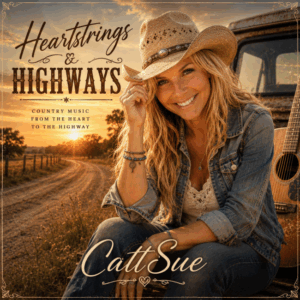
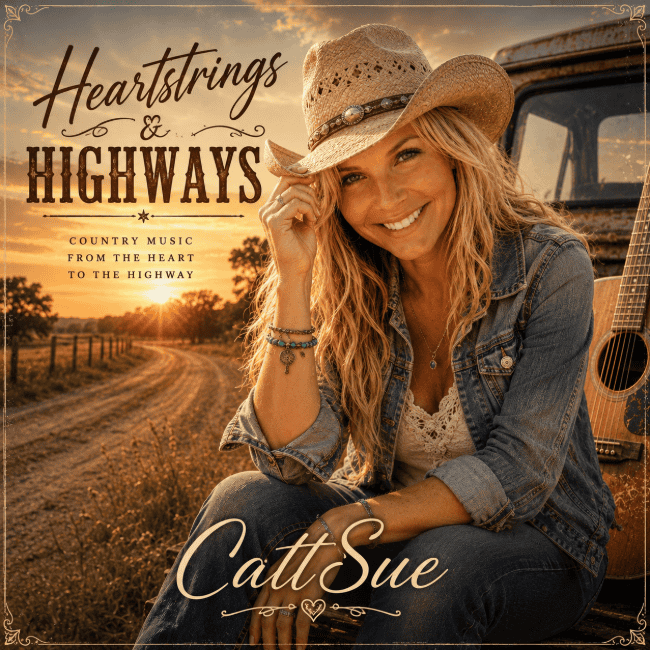
CattSue’s Heartstrings and Highways proposes something different: the road is where everything you thought you left behind gets in the car with you.
Parents. Children. Lovers. Regret. Faith. Addiction. Memory. The half-remembered sound of a voice you have spent most of your life trying to hear again.
Across 11 songs, CattSue keeps returning to the same question in different forms: what exactly survives when the moment itself is gone?
Sometimes the answer is almost absurdly small.
In “A Whisper on the Wind,” written for the mother CattSue lost when she was four and a half years old, memory does not arrive as revelation. It arrives as a Mrs. Beasley doll, photographs, National Park, New Jersey, and the knowledge that a child can remember holding something more clearly than she can remember the sound of her own mother’s voice.
There is something brutal in that imbalance.
American songs have always been filled with ghosts, but most ghosts are romanticized. They wait beside railroad tracks, stand beneath neon signs, or wander through some mythic Southern night. CattSue’s ghosts are less theatrical. They live in family rituals.
“More Time” remembers a father through a bench, a river, Sundays watching the Eagles, and the words he left behind: faith in his daughter, spoken so plainly that they became permanent.
The song understands something fundamental about grief. We imagine we want one last grand conversation, but what we really want is another ordinary day.
That idea runs through Heartstrings and Highways. The record is full of ordinary things charged with unbearable meaning.
“Little Man” begins with footsteps down a hallway. A boy climbs from his crib, runs toward his mother, grows up, and eventually becomes the one holding her hand. Nothing supernatural happens. Time simply does what time does, which may be the most frightening thing on the record.
“Mother’s Heart” rejects the sentimental mythology of motherhood almost completely. Sacrifice does not guarantee reconciliation. Love does not erase disappointment. A mother can give everything and still discover that devotion offers no immunity from heartbreak.
Then comes “Broken,” where survival is stripped of triumphalism. The narrator is still standing, but that does not mean the damage has disappeared.
“In the Light” pushes the record beyond private memory. Written for survivors of trafficking, abuse and exploitation—and informed by CattSue’s connection to a family member and friends who were trafficked—the song insists on identity after violation.
Its central gesture is reclamation.
Not pity. Not rescue.
Reclamation.
A name. A voice. A life.
That makes it one of the album’s most important songs because it changes the direction of the record. Memory is no longer simply something carried backward. It becomes something that can be transformed into testimony.
The final song, “When the Clouds Come Home,” co-written with David Murphy, takes on addiction.
The title is better than it first appears.
Addiction here is not a stranger. It comes home.
The clouds know the address.
Thunder, lightning, darkness—these are familiar presences returning to familiar ground. The song captures the terrifying intimacy of addiction: the sense that the thing threatening you already knows the way inside.
Yet the song also turns outward. “We’re all in this war.” The isolated addict becomes part of a collective struggle.
That movement—from solitude toward solidarity—is the quiet architecture of Heartstrings and Highways.
CattSue does not make mythology out of herself. She does something harder.
She lets the memories remain human-sized.
And in doing so, she finds what American song has always been looking for somewhere between the highway and home:
proof that the people we lose do not disappear.
They become the road.