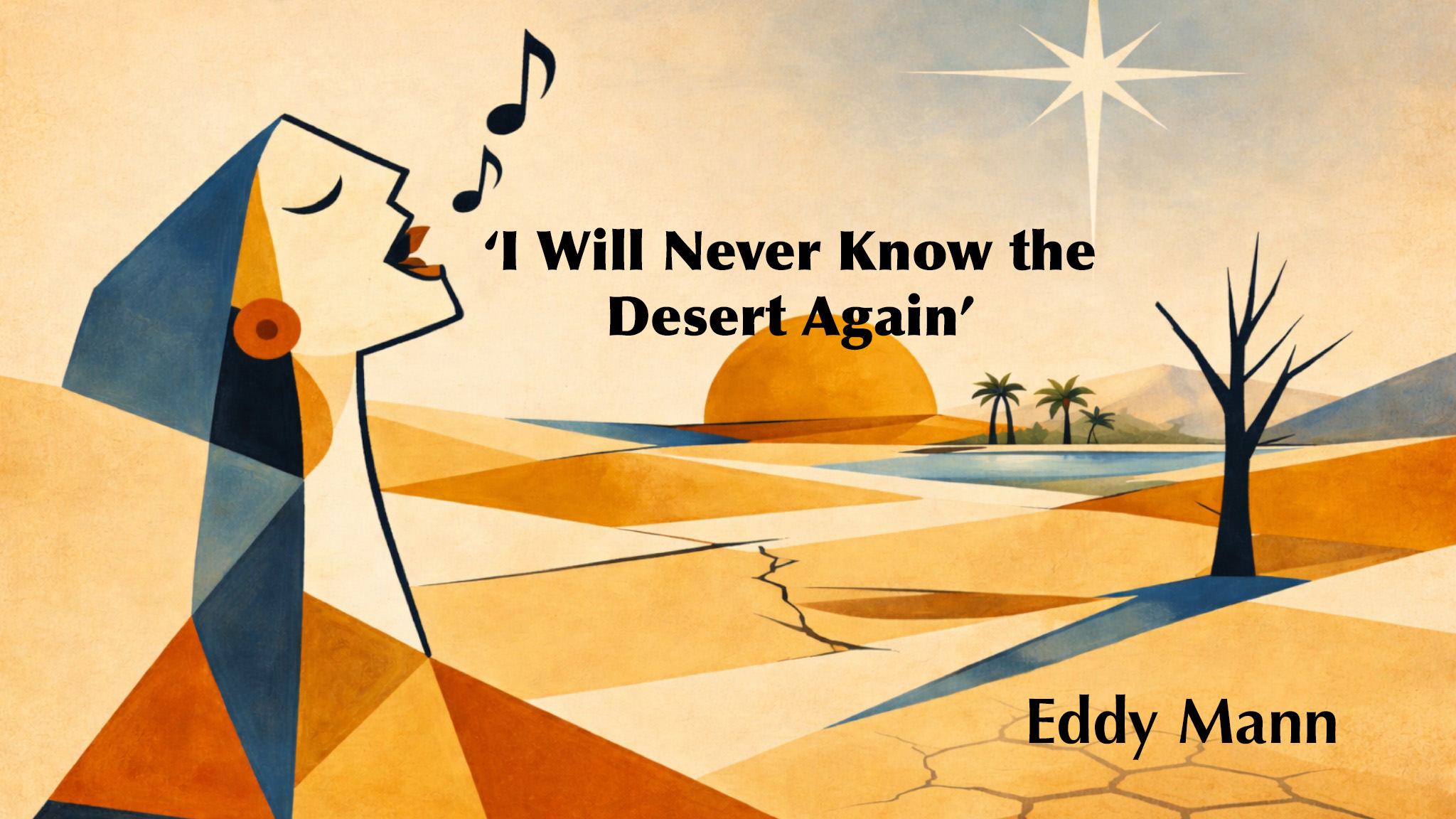
The most effective spiritual music often succeeds not through grand declarations of faith but through its willingness to acknowledge uncertainty, fatigue, and longing. Eddy Mann understands this well on “I Will Never Know the Desert Again,” a contemplative and emotionally resonant single from his latest album, The Unveiling.
Inspired by Revelation 7:16-17, the song explores themes of restoration and eternal peace, envisioning a place beyond earthly suffering where hunger, fear, and isolation no longer exist. Yet Mann approaches these ideas with notable restraint. Rather than delivering the lyrics with overt evangelical fervor, he frames the Biblical imagery through the lens of human vulnerability. The result is a song that feels less like a sermon than a meditation.
Musically, “I Will Never Know the Desert Again” occupies a comfortable space between Contemporary Christian music, Country Pop, and acoustic Americana. The arrangement is understated but effective. Gentle acoustic guitar patterns form the song’s backbone, while subtle atmospheric textures and restrained percussion help establish an expansive, reflective mood. The production avoids the heavily layered crescendos common to much contemporary worship music, choosing intimacy over spectacle.
That decision serves the song particularly well.
Mann’s vocal performance is grounded and unpretentious. His voice lacks the theatrical polish often emphasized in mainstream Christian radio, but that works to the song’s advantage. There is sincerity in his delivery, especially during lines such as “Never to thirst for a faithful friend” and “Never to doubt a life of favor.” He sings with the calm conviction of someone reflecting on lived experience rather than presenting abstract theology.
The recurring image of the “desert” functions effectively throughout the song. While clearly rooted in scripture, the metaphor also operates on a broader emotional level. The desert becomes symbolic of personal hardship, loneliness, emotional exhaustion, and spiritual searching. Mann wisely leaves enough interpretive space for listeners to apply the imagery to their own circumstances.
The chorus — “For the Lamb on the throne will be my Shepherd” — introduces the song’s central message of comfort and reassurance. Importantly, Mann resists overselling the emotional payoff. The performance remains measured, even during the song’s most overtly spiritual moments. That restraint gives the material credibility. Instead of demanding emotional response, the song quietly earns it.
One of the strengths of “I Will Never Know the Desert Again” is its pacing. The song unfolds gradually, allowing its themes to emerge naturally rather than rushing toward catharsis. In an era when many recordings seem engineered for immediate impact, Mann’s patience feels refreshing. The arrangement breathes, and the song benefits from that openness.
Lyrically, the writing is direct and accessible without becoming simplistic. Mann avoids overly ornate phrasing, relying instead on repetition and plainspoken imagery to communicate the song’s emotional core. The simplicity of lines such as “I will never know the desert again” reinforces the sense of longing and eventual release that defines the track.
There is also a notable maturity to Mann’s artistic approach. He does not appear interested in chasing contemporary production trends or commercial formulas. Instead, “I Will Never Know the Desert Again” reflects the work of an artist comfortable with subtlety and emotional honesty. That confidence gives the song a quiet durability.
While firmly rooted in Christian themes, the track’s appeal extends beyond strictly religious audiences. Its exploration of perseverance, comfort, and the hope of eventual peace resonates on a universal level. Listeners need not share Mann’s theological framework to recognize the emotional truths embedded within the song.
In the end, “I Will Never Know the Desert Again” succeeds because it understands that spiritual music does not always need to overwhelm in order to move people. Sometimes the strongest statement is delivered softly.
Eddy Mann’s latest single embraces that philosophy with grace, humility, and understated skill.
–Michael Bane