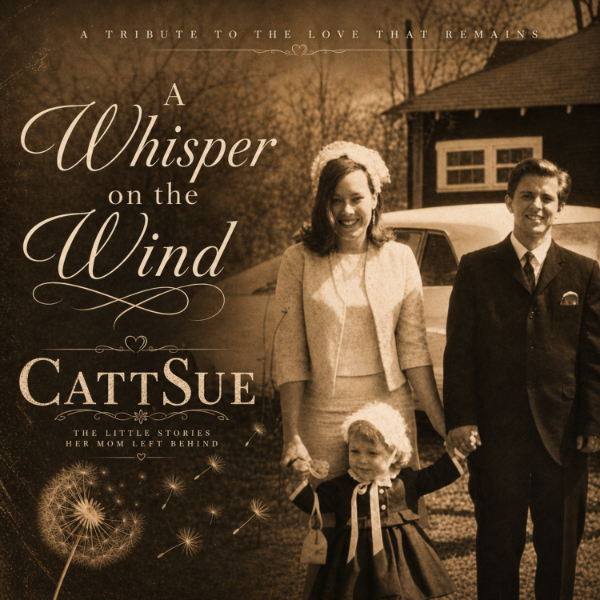
Popular music has long been filled with songs about loss. Some seek catharsis through grand gestures; others memorialize absence with sentiment or nostalgia. CattSue’s “A Whisper on the Wind” chooses a more difficult path. It dwells in uncertainty, memory, and the small details that remain when much else has faded. The result is a quietly affecting song that finds emotional weight not in what it declares, but in what it remembers.
The song begins with a child’s perspective. CattSue recalls carrying her Mrs. Beasley doll through the confusion that followed the death of her mother when she was four and a half years old. The image is specific enough to feel lived-in rather than literary. Childhood grief often exists without vocabulary; children attach meaning to objects because they cannot yet articulate the emotions surrounding them. “A Whisper on the Wind” understands that reality and builds its emotional foundation upon it.
What follows is not a chronological narrative but a conversation between past and present. The adult singer looks back through photographs, trying to reconstruct a relationship that was interrupted before it could fully form. She remembers expressions, imagines conversations, and searches for traces of a woman she barely had time to know. The song’s central tension emerges from that search: how does someone maintain a connection to a person whose memory is incomplete?
Musically, the arrangement mirrors that question. The production is understated, blending elements of contemporary country and singer-songwriter pop without calling attention to itself. Acoustic textures provide warmth while leaving ample space around the vocal. Nothing feels rushed. Instead, the song unfolds at a pace that allows reflection.
CattSue’s voice serves the material well because she avoids exaggeration. Many contemporary ballads rely on increasingly dramatic vocal performances to signal emotional significance. Here, restraint becomes the source of power. Her delivery suggests someone sharing a deeply personal story rather than performing one.
The chorus arrives with a sentiment that could easily become overly familiar in lesser hands:
“You’re my beautiful angel, watching from above.”
Yet the lyric works because it emerges naturally from the song’s context. Rather than presenting an abstract spiritual idea, CattSue grounds it in personal experience. The line reflects a daughter’s attempt to maintain a relationship across time and absence. More importantly, the chorus introduces a surprising perspective on loss. Instead of focusing solely on what was taken away, she acknowledges gratitude for the time she did have.
That emotional balance prevents the song from becoming overwhelmed by sadness. Grief is present throughout, but so is appreciation. The two emotions coexist, creating a more complex portrait than simple mourning.
The bridge provides the song’s most revealing moment. CattSue admits she cannot remember her mother’s voice or the way she spoke her name. It is a devastating realization, one that many listeners who have experienced early loss will immediately recognize. Memory can preserve feelings while allowing details to disappear.
Rather than ending with that absence, however, the song imagines a response. The singer hears words she believes her mother would say today: encouragement, pride, and reassurance. The moment is not presented as certainty. It exists somewhere between memory, faith, and hope. That ambiguity gives it emotional credibility.
“A Whisper on the Wind” ultimately succeeds because it treats grief as an ongoing relationship rather than a completed event. The title itself suggests something fleeting yet persistent: a presence felt rather than seen, heard rather than proven. Throughout the song, CattSue returns to the idea that love can survive incomplete memories and unanswered questions.
Following the success of her debut single “Come Home to Me,” CattSue continues to establish herself as a songwriter drawn to intimacy rather than spectacle. “A Whisper on the Wind” is a modest song in scale, but its emotional reach is considerable. It understands that the most enduring connections are often carried not in certainty, but in the quiet spaces where memory and imagination meet.
–John Parker