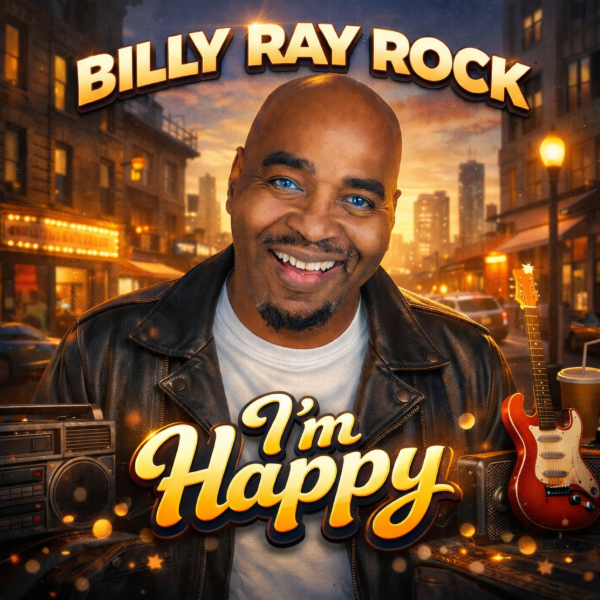
Billy Ray Rock’s “I’m Happy” begins like a rumor you overhear through a passing car window at a red light—a bassline moving slow but certain, a beat that doesn’t push so much as glide, and then a voice, casual and unworried, saying something that in 2026 almost sounds suspicious: I’m happy.
Not ecstatic. Not redeemed. Not spiritually enlightened. Just happy.
And that word hangs there like a challenge.
American popular music has always had a strange relationship with happiness. The old blues singers often disguised survival as humor. Early rock and roll transformed frustration into motion. Disco made joy feel political because it insisted people deserved release. But somewhere along the line, especially in the digital age, pop music learned to distrust uncomplicated pleasure. Sincerity became something to apologize for. Every emotion required quotation marks around it.
Billy Ray Rock ignores all of that.
“I’m Happy” isn’t ironic enough for the internet, and that may be its greatest strength.
The song unfolds in fragments of ordinary victories: green lights, paid bills, Friday night freedom, escaping stress long enough to breathe. These are not fantasies of wealth or domination. They are glimpses of temporary peace in a culture built to prevent it. The chorus repeats:
“Because I’m happy… it’s something you should know ’cause I feel good, yo…”
On paper, the line barely exists. But records are not literature. They are voices occupying time. And Billy Ray Rock delivers the phrase with the relaxed conviction of someone who understands that repetition is not emptiness—it’s ritual. By the third time through, the chorus stops sounding like a statement and starts sounding like resistance.
The groove carries much of the song’s emotional meaning. The production is sparse enough to breathe but steady enough to trap you inside its rhythm. Nothing lunges forward demanding attention. Instead, the beat rolls with the patient confidence of old neighborhood music—records made for kitchens, block parties, late-night drives, and moments when people briefly forgot the machinery pressing against their lives.
There’s a lineage hiding underneath “I’m Happy.” You can hear echoes of post-disco R&B, independent soul singles, street-corner celebration records that understood music not as escape from reality but as a strategy for enduring it. Billy Ray Rock updates that language without polishing away its humanity. The song retains looseness. Air remains in the track. Imperfection survives.
That matters because happiness, in this song, is never presented as total victory. The stress still exists. The “drama” still circles nearby. The clouds are visible even if “I got no rain.” The song’s optimism depends entirely on the fact that trouble has not disappeared. Billy Ray Rock isn’t denying the world; he’s refusing to surrender to it.
His vocal performance reinforces that tension. He doesn’t oversing or dramatize emotion. He sounds conversational, even amused at times, as if happiness itself is slightly unbelievable but worth holding onto anyway. There’s confidence in the delivery, but not arrogance. More accurately, there’s relief.
And maybe that’s the real subject of “I’m Happy”: relief as modern luxury.
The song arrives during a period when public exhaustion has become permanent background noise. Social media monetizes outrage. Streaming culture rewards melancholy. Much of contemporary R&B either sinks into emotional isolation or inflates itself into empty luxury fantasy. Billy Ray Rock chooses another route entirely. He celebrates a good day.
Not a perfect life. A good day.
That distinction gives the record weight far beyond its apparent simplicity.
By the end, “I’m Happy” feels less like a commercial single than a small document of personal insistence. A reminder that joy does not have to be profound to matter. Sometimes happiness is simply waking up, catching green lights, hearing a rhythm hit correctly, and deciding—despite everything—not to let the darkness narrate the story for you.
–Marcus Grey