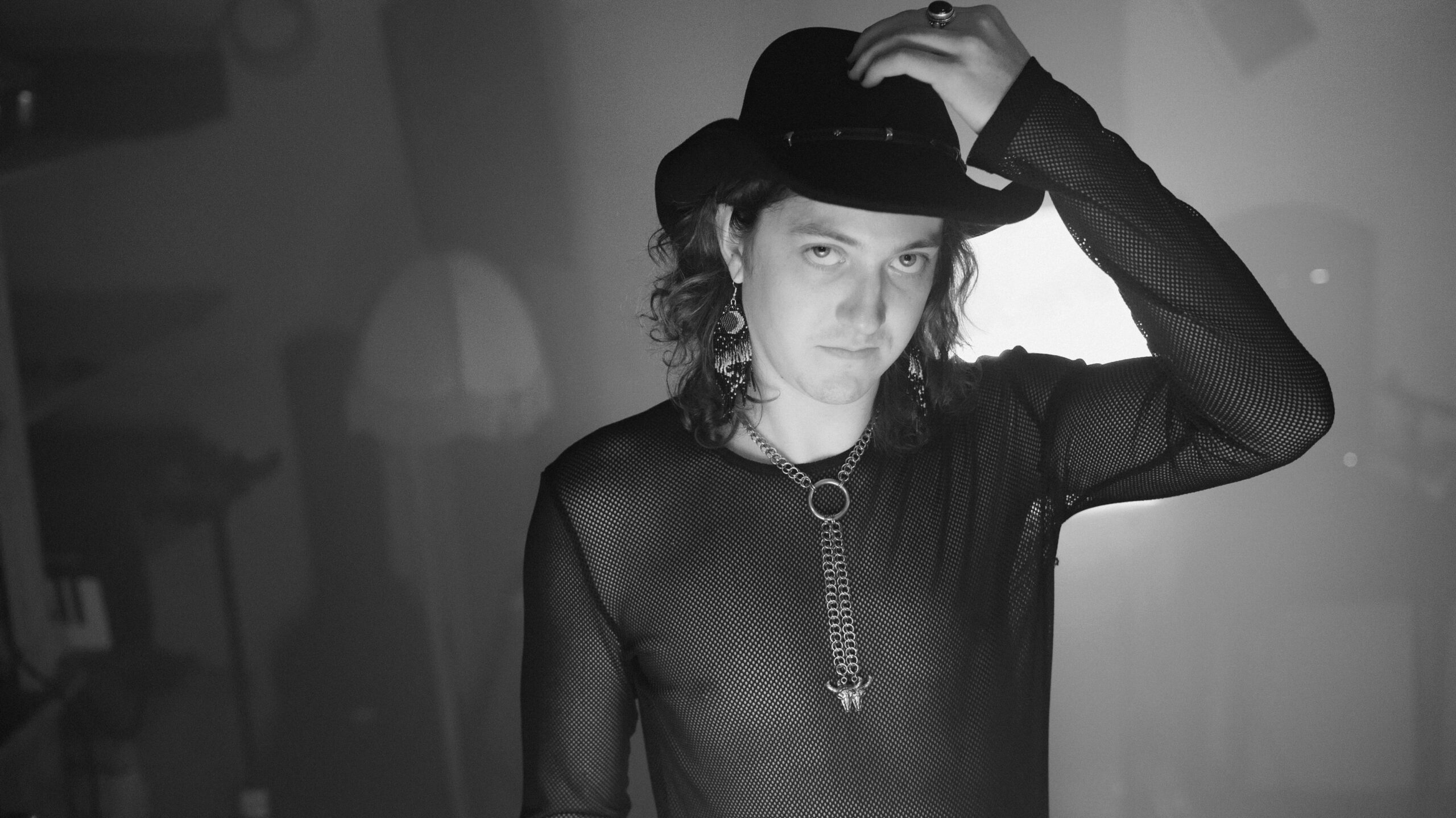
Fraser Wayne and the Desert Eagles deliver something hauntingly evocative with their full-length record, Follow the Darkness into the Light. Seamlessly blending elements of gothic country and rock this LP is a great touchstone work for the Ontario-born songwriter. Backed by the rich, textured instrumentation of the Desert Eagles, Wayne navigates the complex, shadowy valleys of human the emotion, as the listener is pulled into an atmospheric, cinematic landscape that feels both timeless and personal.
Opening tracks like “Memories Like A Home” establish a deep sense of yearning, setting a melancholy and honest tone for the rest of the journey. Throughout the record, the pedal steel guitar acts as a perfect foil to Wayne’s crooning vocal delivery. In the standout track “Painted Blue,” Fraser showcases their ability to layer acoustic and electric arrangements without losing the song’s emotional core. Meanwhile, the driving rhythm of “Living On The Road” perfectly captures the spirit of traveling across the country through the window of a van. It functions as a meditation on transience, anchored by a steady pulse and backing vocals that elevate the track’s choruses.
Lyrically, Wayne dives headfirst into themes of identity, struggle, and resilience, offering an authentic perspective to the country genre. Tracks like “Autumn Song” feel like a gentle exhale, capturing the seasonal transitions of both nature and the human heart. The production keeps the band sounding organic and alive, as if they are playing right in front of you in a dimly lit dive bar. Every drum hit and piano flourish has its place, allowing the stark, honesty of the storytelling to remain at the forefront. Ultimately, Follow the Darkness into the Light is a beautifully bruised record that rewards listeners unafraid to confront the shadows.
We sat down with Fraser to learn all about the new record, exclusively here at Music Crowns.
—
Your new album, ‘Follow the Darkness Into the Light’, brings together influences like Canadiana, folk-rock, and even spaghetti western soundtracks. How did you go about balancing those worlds without losing a sense of cohesion?
I guess those sounds are kinda the core of who I am as a musician, so I don’t even really think of trying to balance them. Those genres and sounds are all reflective and complimentary of each other, so the cohesion is a natural thing. I think a couple of spooky songs, a couple of country rockers, a couple of folk rock jams, and a few odd balls seems like a decent recipe to me haha.
When did the idea of building a narrative universe around The Cowboy and The Spectre first take shape?
It was originally just an idea for a short film, where I wanted to string together the “spooky” section of the album and follow a narrative with a cowboy that had an unknown presence following them through the woods. That spark originally came from the song “Walking Through The Woods,” which lead me to dig deeper creatively into the next 2 songs. For Last Times In Tull, I wanted to recreate the general feeling of unease (and a killer zombie shootout) of a section of Stephen King’s “The Gunslinger,” upon which the song is heavily based off of. And in order to wrap up the trilogy of songs, for “Down In The Grave,” we enter a graveyard and witness a group of skeletons dancing around me while I dig my own grave. I guess it all originally stemmed from the desire to fuse my two passions together – music and film. After hanging out and brainstorming with Kyle Popovich, we decided to take the video series even further and create stand alone music videos to introduce both The Cowboy and The Spectre characters. Kyle was a great help with expanding the universe and helping my ideas come to life exactly as I had envisioned them, and I’m really excited to get to work on the short film with him later this year!
There’s a strong sense of duality running through the record – grief and hope, darkness and light. How intentional was that theme during the writing process, and did it evolve over time?
I think I originally just looked back and collected these songs from a few different periods of my life, along with some new stuff that felt right. I didn’t have a concept at first. The themes and overarching story started to bubble when we were recording the demos. I spent a lot of time listening to them over and over and over again and I think that’s where the thematic elements started to jump out at me. There is a specific line in the title track that originally said “save me a seat in the sacred light, follow the darkness into the night,” and upon discussing in depth with an ex-partner I decided to take their advice and change the line to “save me a seat in the sacred night, follow the darkness into the light,” and I think that really made sense to me at the time, and this evidently brought the theme of the album to light. Life is full of moments where grief and hope stand side by side holding hands. I think I like to bring those moments together in my music when I can.
“Painted Blue” and “Autumn Song” both introduce key visual characters in the album’s wider story. How important is visual storytelling to how you experience this music?
Visual storytelling has always been an interest of mine. I think this probably comes from my obsession with Michael Jackson’s music videos and short films when I was growing up. I used to have a DVD that had all of his music videos and short films strung together on it, and I would watch it on repeat over and over again haha. Especially the Thriller video (which probably lead to my obsession with horror movies). For my very first album, way back when I was 18-19, I collaborated with a friend in Ottawa and made these trippy videos on Windows Movie Maker to accompany all of the songs – and every album since has had some kind of visual accompaniment, usually in the form of various music videos (always at least one of them shot with an old camcorder). Having a visual element adds another layer to the music and allows it to take on a new life, or take on a different meaning than you might interpret through the music alone. So I feel like it allows for the album to have a second breath. You can listen to the record at home and have that experience.. or you can attend the screening in October and have another experience… or watch the VHS tape and have a totally different experience.
How much of this record is rooted in real geography versus emotional or fictional landscapes?
I think the emotional and fictional landscapes are almost inseparable from the real geography I speak about in my songs. The moods of the music and lyrics are directly affected by the seasons, or the land I’m living on, where I’m travelling, or working, etc. I bleed my music very honestly, so for me it’s hard to find the difference between the real / emotional / fictional landscapes. I’ve been writing poetry since I was very young, so I think its natural to say something like “I won’t let this autumn leave me high, I won’t let these leaves bring me down” as a way to bring my natural surroundings into my emotional landscape. In songs like “Living On The Road,” I am speaking much less metaphorically about the geography haha. “Think I’ll go out a little farther, out to Vancouver harbour, and watch the ships roll in behind the mountains,” and other direct references to places in Canada, were written after spending some time travelling around BC, Alberta, and the Northwest Territories.
The album features contributions from musicians across multiple notable Toronto and Canadian acts. How did those collaborations influence the final sound?
I’m lucky enough to have recorded this album with my best friends! I always wanted to record an album and tour with Vypers as my backing band, but since they are down defunct, I cherry picked those guys (Nic, Liam, Pat) from the respective bands they play with now, and added Jake on pedal steel and Dorrie on fiddle. Jolie and Freddie came in a little later to track their vocals. That’s pretty much how the album came to be. The band has completely changed form since then, and my touring group now contains a new fiddle player (Ally Corbett) plus Michele and Liv from Easy Rider on pedal steel and bass. I feel lucky to have Mr. Roy playing drums, overdubbing piano, and producing / mixing the whole dang record. He’s always been down to help me mix and/or master my home recordings, but making the decision to record the entire album with him at The Sound Department in Toronto, really made the sonic quality of the album fit my vision perfectly (live off the floor, minimal overdubs, heavy harmonies, like an old Neil Young record haha).
And finally, what do you hope listeners take away after stepping into the world of Follow the Darkness Into the Light?
I hope people have a good cry haha. I think that’s what my songs often do for people. Hopefully you guys can experience the ups and downs of being human in these songs, and I hope you can relate to them in your own way. I hope these songs can help ease your grief, or help you feel less alone. Although it leans into the darkness, there is actually so much hope in this album. I think that songs have the potential to be very powerful, and they can guide us like a lantern in the dark. Maybe these songs can help you in some way. I dunno, I gave you a very honest look at my inner world, so do what you will with that. When the video series drops, I hope you enjoy my eye for horror cinema and allow yourself to get immersed in the experience.