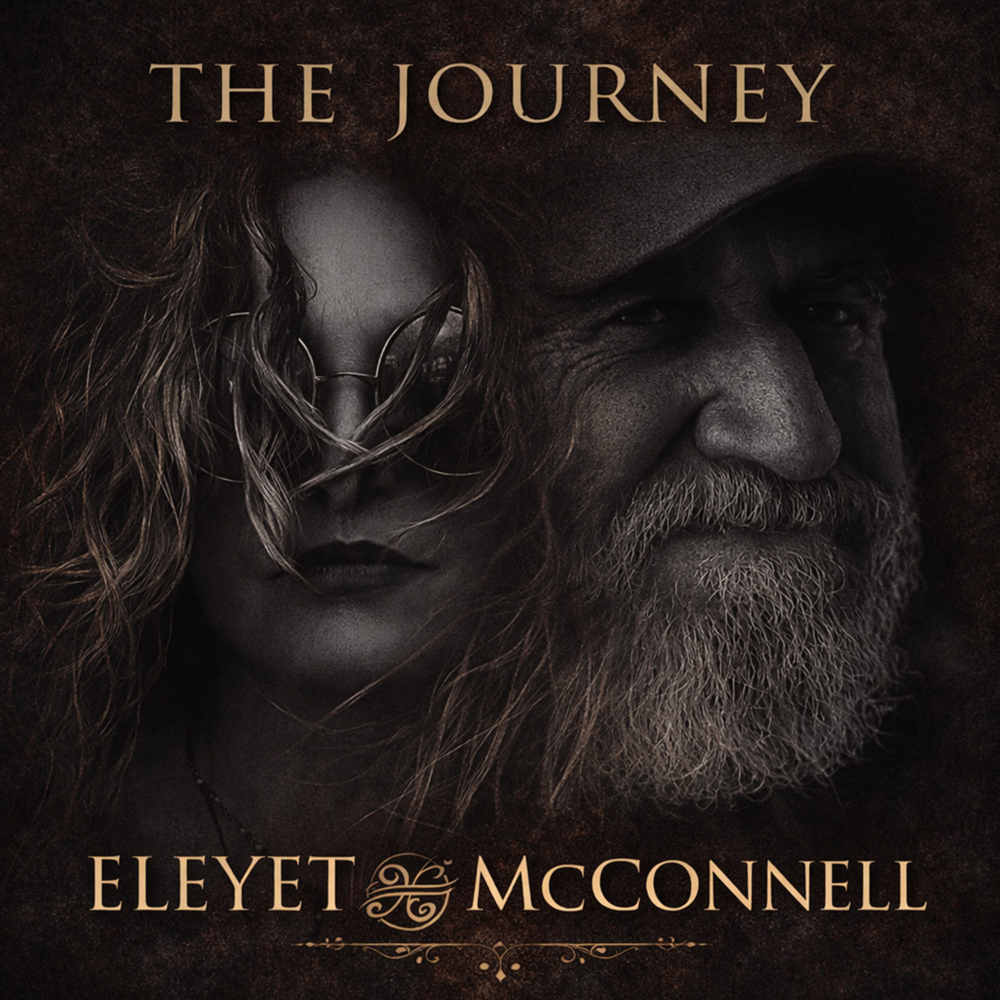
On The Journey, Eleyet McConnell resist the easy arc of transformation. There’s no clean before-and-after here, no sweeping declaration of reinvention. Instead, the album sits in the harder, more honest space—what it means to keep going while still carrying what happened.
From the opening track, “The Horizon,” the record establishes its emotional terrain: instability, pressure, and the slow pivot toward agency. The song begins in uncertainty—storms looming, outcomes unclear—but quickly shifts into self-definition. “I’ll take it head on; that’s my way” doesn’t read as bravado; it feels like a boundary being drawn. Sonically, the band leans into a classic rock framework—guitars, steady percussion—but the restraint is notable. Nothing is overplayed. The arrangement supports the emotional movement rather than distracting from it.
That sense of containment becomes more charged on “The Ledge,” one of the album’s most direct confrontations. The lyrics address manipulation and control without metaphorical distance. Repetition—“my way”—functions less as emphasis and more as insistence, mirroring how autonomy is often reclaimed in real life: not once, but repeatedly. The instrumentation follows suit, tight and unembellished, reinforcing the song’s emotional tension.
Midway through the album, The Journey pivots inward. “Your Eyes” slows the pace, allowing memory to surface. The song reflects on time’s passage and the persistence of connection, but it avoids sentimentality. Angie McConnell’s vocal delivery is measured, almost observational, which gives the lyric space to resonate. It’s not about reliving the past—it’s about recognizing its ongoing presence.
“King of Glass” introduces one of the album’s clearest metaphors: fragile authority, sustained by illusion. The imagery is direct, but effective. As the song unfolds, the idea of truth as something that rises—unavoidable, revealing—becomes central. The band maintains a steady groove, allowing the concept to carry without overstating it.
“Without You” shifts toward vulnerability, but again, the album resists resolution. The lyrics acknowledge regret and the possibility of reconnection, but they don’t guarantee it. The repeated “fallin’ again” suggests both desire and risk, underscoring how returning—to a person, to a version of oneself—is never simple.
The title track, “The Journey,” functions less as a conclusion and more as a framing device. Growth is presented not as a destination, but as a process shaped by friction. That idea carries into the closing song, “Dreamy,” which gestures toward hope without fully arriving there. The imagery of storms and rubble remains, but so does the possibility of something beyond them.
What distinguishes The Journey is its refusal to dramatize its own resilience. There are no grand gestures, no exaggerated peaks. Instead, the album focuses on the quieter, more difficult work of persistence. The production reflects this approach—clean, balanced, and unobtrusive—keeping the emphasis on songwriting and performance.
In a landscape where emotional expression is often amplified to the point of abstraction, The Journey feels grounded. It understands that survival isn’t always visible, and that strength doesn’t always announce itself.
Sometimes, it just keeps moving forward.
–Jennifer Hopkins