Hardy Mums is a perennial band led by producer Eddie Ashworth, and boy, do they bloom in a wide palette of hues! This collective has an ever-evolving sound and showcases a rich assortment of guest vocalists. Like Scott Bradley’s Postmodern Jukebox, the era and genre may change at the flip of a switch; this enigmatic collective often revolves in decadent rock and pop spheres.
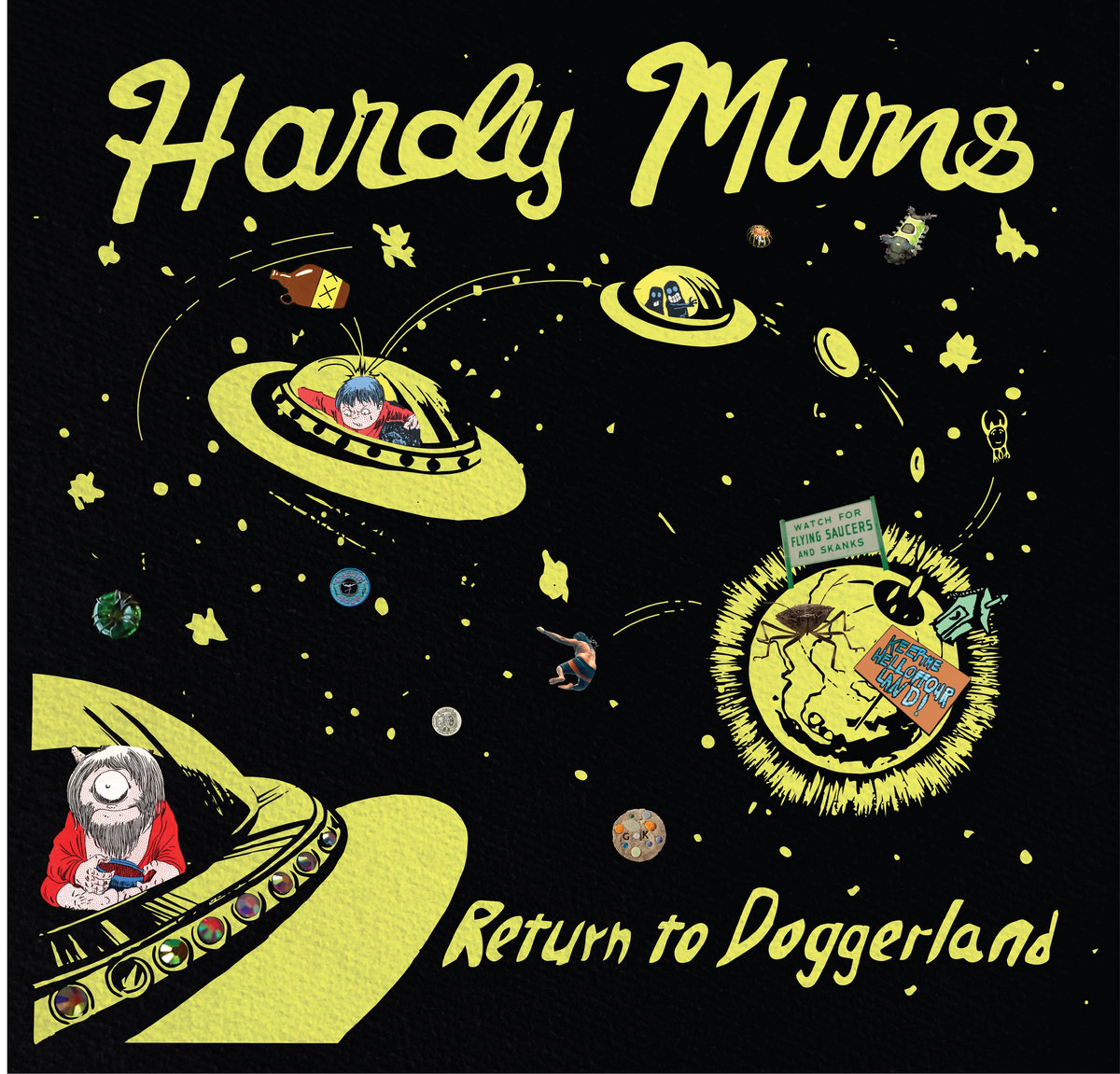
The combo’s debut LP, “Return to Doggerland” is a diverse 11-track exploration of sounds. This album has already been dubbed both a “romp” and a “glimpse from the future”. Inside it, you’ll find folk, rock, psych, and pop…. echoes of South American Bossa Nova and Sambas, electronica, and bluegrass.
The short opening track is mysterious and ethereal, with its phasing backdrop and melodic synth atop fingerpicked guitar; a spacious soundscape. It shifts into wonderful classical counterpoint, which sees itself immediately into the more raucous “Whip-Poor-Will”
He sings of the Whip-Poor-Will, personifying his love interest as a nocturnal bird; something hungry with desire. The jam overspills with woodland imagery: forest floors, poisoned quills, haunted nests. This one’s full of in-the-pocket rhythm guitars and a poignant push and pull. He doesn’t understand her, she’s reopening old wounds, and they are descending… We wonder, are they going down together?
“Cuttin Sage” takes us on a short trip to Southeast Asia with its talking drums, which blend with a soulful rhythm section. What once was a smoke-filled bar and southwestern forest has now turned into a new-age coffee shop. An ethereal, jazzy female voice takes center stage: a stark contrast from the previous track.
Then “Muldoon” is a peppy ska-rock-fusion-jam; bright citrus vocals blend with caramel ones, which meld deliciously at the chorus. One is reminded to pursue one’s beliefs despite life’s hurdles.
As we near the middle of the album, “Green Boots” shakes us with its disrobed bass and defenseless vocals. We’re immediately reminded of classics: The Smiths, Neutral Milk Hotel, and even Simon & Garfunkel, but only because of how candid and unarmed the track is. Despite these comparisons, the tune is more alt-country than anything else! The intensity crescendos, chameleons into a stomping, folky, roots-rock-blend. It’s macabre, it’s honest; a very real feeling account of what a person might have thought before their demise.
“The Almost Lovers” unfolds into a radio-worthy minor 6/8 ballad, with its keyed lines and lush brass. Dallas Craft sees the vocals in with a melismatic oo… An effortless, resonant voice for a big sentiment; paying homage to a love that was once on fire. Ruby-red coals that lost their fuel, turned to ephemeral smoke…
“Something New to Find” then gets us up and moving again after heartbreak; we take to the highway, speeding. The steel slide and 12-string guitar back up a voice that can be described as having Alison Krauss’s purity, blended with the freshness of 2026’s country-folk.
“Pitching Woo” might be a down-to-earth trapse in the 20-aughts; perhaps, someone singing about a lost love from an internet cafe? Hardy Mums build a layer cake of vocal harmonies as they tell this tale of the one who got away. The acoustic guitar make it feel like home, but the lyrics are poetically visceral at times; speaking of cheshire smiles and a girl with silver tongue.
Then, there’s the motivif-tense arpeggios of “Dilettante”, stark against those deliciously crystalline vocals. “Always best to not get caught, swamped by someone’s sinking heart.” The sentiment swells into a dramatic guitar solo, backed by a swarm of patterns, licks, and rolling percussion. Somehow, that dense fog manages to lift and turns into the timeless and endearing “Next Train to Clarksburg”.
Violins and pickin’, with woody guitars, grow the greenery; the intro could easily back up a bluegrass great like Tim O’Brien. A picturesque scene arises; life overspilling in the hidden gem of Clarksburg. In the center of this scene, he and she… The old, closed train station is embedded with their invisible memories. She sings in a plainspoken musical narrative with crisp enunciation and a delicate hint of vocal fry.
Threaded through “Return to Doggerland” are tastes of the continent, shards of intimate moments, that which is both harrowing and golden. But the last track is a testament to mankind’s better nature; that, despite our longing, we still can go through life teeming with hope and eternal merriment.
—
At what point did you realise this project in Hardy Mums was bigger than a solo record?
Originally I thought it was going to be a proper band project with me singing lead vocals, mostly, but as the songs developed over the course of time (and different folks became involved in the recording) the constraints of that approach seemed to limit the potential of each song.
To be honest, for this batch of tunes the last thing I personally wanted was to hear just me singing for 40 odd minutes! So that key decision to “cast” each song with a lead singer who really fit each tune opened up the possibilities of where each track could go, and I think ended up working out. Plus, I really wanted to collaborate with some of the artists I had produced in the past, turning the tables a bit as they say.
‘Return to Doggerland’ brings together collaborators from different countries, backgrounds and musical styles. How did you keep such a wide-ranging project feeling cohesive?
At first I wasn’t really thinking about how everything fit together, in fact the fun part was not worrying about that at all. Mixing up elements of various genres and musicians who hadn’t worked “together” before (especially within each song) kind of became the style. I had some precursors for inspiration: Dark Night of the Soul by Danger Mouse and Sparklehorse is a devastating album that has an array of featured vocalists and divergent styles but still sounds of like it could be a band thanks I think to Brian Burton’s clear vision and sure production hand.
The Golden Palominos albums also feature lots of diverse singers and players and writers, artfully placed alongside each other in the album sequence and they’re all great. I also tried to capture some of the vibe of the cool sampler LPs that record companies put out back in the day.
It helped to have a core group of musicians (Bryan Gibson and Eric Mrozkowski on drums, Rebecca Harrison and Mike O’Neal on bass, Pete Sebastian and Zane Smith supplying much of the guitar work, and me as utility player) to make the sonic palette of the album consistent. Also, the featured vocals are split more or less evenly between male and female singers, which I think provides a kind of symmetry to things.
Lyrically the album has a thematic throughline of movement and travel, and the people, places, and experiences encountered on the way. That happened unintentionally but helps keep the narrative voice of the thing consistent, no matter who contributed to each song or who sang it.
Finally, since the record is meant to be listened to as a whole piece, we did work hard in the mixing and mastering stages to give each track the same kind of sonic “weight” no matter the changing instrumentation.
The album moves effortlessly between indie rock, folk, bluegrass, dub, Brazilian influences and classic singer-songwriter traditions. Was there ever a temptation to narrow the sonic palette, or was embracing diversity always the goal?
Once it got going that way it was full speed ahead, no looking back! Without putting this album in their league, I really wanted to play in the same sandbox as King Gizzard and the Lizard Wizard, Geese, and Drink The Sea, all of whom craftily veer from one style to another, often in the space of a single track. But they also imbue their songs with authenticity, commitment, and emotional depth, which to me provide the glue that holds the divergent combinations together.
Who are your biggest influences?
So many. From a songwriting perspective I really admire Robyn Hitchcock, Ray Davies, Aimee Mann, Jimmy Webb, Aldous Harding, Nick Drake, Laura Nyro, early Randy Newman, Jeffrey Martin, among others.
I’m pretty omnivorous, artist-wise, but I especially love XTC, Badfinger, Sergio Mendes and Brasil 66, Squeeze, Colin Blumstone, Leon Russell, Sugar, Joni Mitchell, all the English pub rock bands, and The Beatles and Kinks of course. Big fan of west coast rock and folk from the 1970’s. Love the classic Monkees records. King Tubby and Lee “Scratch” Perry are rarely far from the turntable. Currently listening to a lot of the Guruguru Brain influenced stuff from Japan (Kikagaku Moyo, Ongaku Moyu, and Go Kurosawa), Psychedelic Porn Crumpets, Satellites, Juana Molina, La Vuela Puerco, Liam Bailey, Emma Swift, White Denim, and Soundtrack Of Our Lives. OK, I’ll stop there!
From a production standpoint, I love the work of the great EMI engineers (particularly Ken Scott and Geoff Emerick), Eddy Offord’s records with Yes, Nigel Godrich, John Agnello, George Martin, Gus Dudgeon, John Parish, Brendan O’Brien, Jon Brion, Susan Rogers, John Wood, among others.
Having spent decades producing artists across punk, reggae, rock and hip-hop, how has your work behind the mixing desk influenced the way you approach your own songwriting?
At this point for me mixing and writing operate on a continuum—the song creation and recording side of things are kind of intertwined. Some tunes begin with a recorded track or riddim that a song is written to, whilst others begin more traditionally as a “sit down and write it” kind of thing with acoustic guitar or piano before considering its musical setting—but eventually it all gets put in the blender.
My own recording studio is set up so I can transition from one type of production to another fluidly, so that’s how I tend to plonk away on my own material. Of course, when I work as a producer the process is a bit more intentional and tailored to suit the workflow of the artist.
What made that ‘Muldoon’ the ideal introduction to the world of Return to Doggerland?
With the album coming out in the summer and all, we just thought it was the most traditionally catchy and upbeat of the batch and kind of feels like a tonic for the anxiety that pervades society at the moment. Ashley LaRue wrote the wonderfully positive lyrics and melody (along with Benny Coleman in the verse) and their duet captures the coastal reggae/rock vibe that we wanted to have represented in at least one song on the album.
Also, since the Mums at this point are a recording project only (though that may change…) having both Ashley and Benny out there right now touring extensively with their own bands (along with the video we made of “Muldoon”) provides some tangential exposure for the record.
You’ve worked with everyone from Sublime and Pennywise to Blackalicious and Tommy Shaw. Are there lessons from those collaborations that still shape the way you make records today?
Yes, definitely. First, on any project I’m producing and recording I take my cues from the artist I’m working with—I’m there to make their vision of a reality, not impose my own, initially at least. Make them comfortable with the process and make it as invisible for them as you can so they concentrate mostly on their own performance spontaneity, where the real magic happens on records. Second, once we’ve established a copasetic working relationship and things are flowing, I lean into my responsibilities as a producer and provide meaningful constructive feedback and creative ideas as appropriate—that’s what they hired you for! Third—and this applies to my own stuff as well–I personally try to make each project sound distinct, its own thing. I hate the cookie cutter approach to making records and my goal is to create a personalized soundscape for each artist.
And finally, what do you hope listeners take away after hearing the record from beginning to end?
That they’ve been on a kaleidoscopic road trip with several twists and turns, a break in the middle, a bit of rain, and a tired yet happy arrival at their destination, subtly but somehow changed and ready to move to the next adventure.
Listen HERE: https://hardymums.bandcamp.com/album/return-to-doggerland