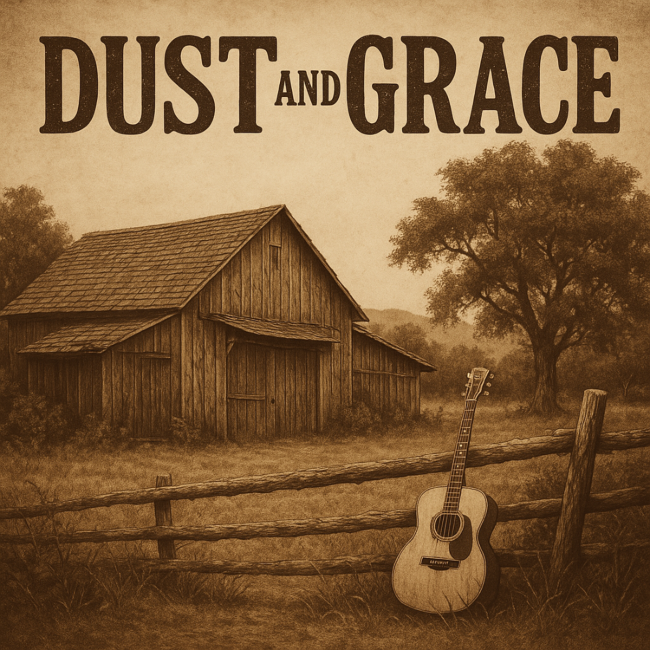
Country music has long trafficked in mythology. The open road. The small town. The church pew. The broken heart. The promise of redemption. What distinguishes Dust and Grace’s self-titled album is not that it embraces those themes, but that it treats them less as symbols than as lived experiences. Across ten songs, songwriter Michael Stover builds a world where faith, family, and community are not abstract ideals but daily practices, stitched into routines, memories, and relationships.
The album’s emotional architecture is remarkably consistent. Nearly every song revolves around a search for belonging, whether through spiritual conviction, romantic connection, family bonds, or attachment to place. The result is a record that feels less like a collection of individual songs than a single narrative told from different vantage points.
“My American Dream” opens the album with a declaration of values. The song’s vision of fulfillment is strikingly modest: children raised with respect, church on Sunday mornings, meals shared around the table, and a life measured not by accumulation but by gratitude. In contemporary country music, where success is often defined by excess, this perspective feels almost radical. Stover’s lyrics reject aspiration in favor of contentment.
That same philosophy echoes throughout “Already There,” one of the album’s strongest compositions. The title itself contains the song’s thesis. Happiness is not somewhere ahead; it exists in the present, embedded within family, faith, and memory. The song’s references to parents, childhood, and perseverance create a portrait of fulfillment that is both deeply personal and broadly relatable.
Faith is central to Dust and Grace, but it is rarely presented as doctrine. Instead, it functions as a lens through which the world is interpreted. “Hallelujah,” the album’s best-known track and recipient of the Independent Music Network Award for Best Inspirational Song, transforms worship into communal celebration. Its repetitive structure mirrors the traditions of congregational singing, inviting participation rather than observation.
Likewise, “He Made It All” finds spirituality in creation itself. The song locates evidence of God in rivers, mountains, laughter, and sunlight. Its perspective is uncomplicated but effective, emphasizing wonder over theology. The message is clear: divinity is not distant; it is present in everyday life.
The album is most compelling when it shifts from affirmation to vulnerability. “Love Doesn’t Live Here” introduces emotional complexity, chronicling a relationship fractured by distance and disappointment. Rather than dramatizing heartbreak, the song lingers in resignation. Its restraint gives it weight.
“Little Footprints” achieves something similar through its reflection on parenthood. The song’s narrative spans generations, tracing children from infancy to adulthood and ultimately to parenthood themselves. The emotional impact comes not from grand gestures but from recognition. The passing of time is presented as both blessing and loss.
Not every song carries such emotional gravity. “Trailer Park Paradise” serves as the album’s comic relief, celebrating working-class ingenuity with warmth rather than condescension. The image of transforming a backyard into a tropical getaway feels simultaneously humorous and sincere. It reinforces one of the album’s recurring ideas: happiness is often a matter of perspective.
Then there is “Voodoo Sway,” the record’s outlier. Filled with dreamlike imagery, whiskey-soaked storytelling, and supernatural flirtation, it introduces an element of playful escapism absent elsewhere. The song’s looseness provides welcome contrast to the album’s more reflective moments.
The closing track, “I’m Comin’ Home,” co-written with Bryan Cole, brings the album’s themes into focus. Home here is more than geography. It represents acceptance, redemption, and peace. The song’s repeated refrain transforms return into a spiritual act.
Dust and Grace is not interested in reinvention. It is interested in affirmation. Its songs celebrate faith without apology, family without irony, and community without nostalgia. In an era where much popular music often prizes ambiguity, this album finds strength in certainty. Whether listeners share its worldview or not, its conviction is undeniable. And conviction, when expressed with sincerity, remains one of music’s most persuasive qualities.
–Joe Camaro